How We Engineered Challenger India's Electric Drive System
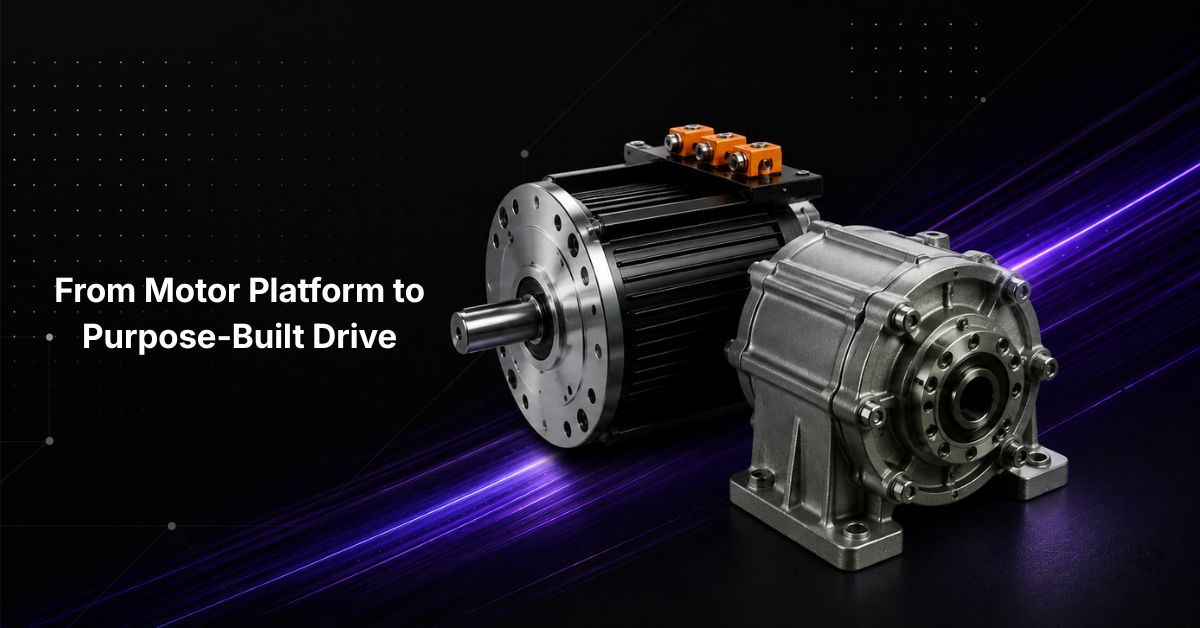
How Procurabl engineered a custom 48V motor-and-gearbox drive for Challenger India's electric sweeping equipment, from an off-the-shelf platform to an application-specific solution.
Industry: Industrial Equipment
Product: 48V permanent-magnet motor + custom-designed 11:1 reduction gearbox
Why Procurabl
Customer Challenge: Challenger India needed an electric drive for its sweeping equipment: four drives per unit, across two configurations, that could hold a consistent output speed (50–150 RPM) and torque (100–300 Nm) as load fluctuated, within a compact 48V battery architecture. No off-the-shelf motor matched that operating envelope on its own.
Capabilities Leveraged: Existing PM03 permanent-magnet motor platform, custom gearbox design and reduction engineering, full electrical-and-mechanical system integration. See our motor sourcing and custom drive engineering services.
Result: An application-specific 48V drive concept, PM03 motor paired with a purpose-designed 11:1 reduction gearbox, validated through RFQ and development stage, converting the motor's high-speed output into the low-speed, high-torque range Challenger's sweeping mechanism required.
Introduction
As sweeping equipment moves toward electrification, the drive system has to do more than turn a shaft. It has to hold controlled, consistent performance inside a compact vehicle architecture running on battery power, while the load on the sweeping mechanism keeps changing underneath it.
Challenger India came to Procurabl with exactly that problem: an electric drive requirement for its sweeping equipment, four drives per unit, with two possible configurations depending on the application's output needs.
The Challenge
The operating envelope was tight. Output speeds needed to run 50–150 RPM, continuous output torque 100–300 Nm, power draw 3–10 kW and critically, the drive had to hold a consistent output speed even as torque and load fluctuated during operation. All of it had to run inside a 48V battery architecture, across both shorter-duration and extended-duration configurations.
This wasn't a spec an off-the-shelf motor could satisfy on its own. It called for a drive engineered around the sweeping application's actual operating characteristics not a motor selected from a catalogue and hoped into place.
The Engineering Approach
Procurabl already had a proven starting point: the PM03, a compact 48V permanent-magnet motor built for high power density and reliability, weighing roughly 8.5 kg with a flange-mounted, keyed output shaft. Rather than designing an entirely new motor from scratch, the engineering team adapted the existing PM03 platform to Challenger's requirements.
The gap was speed. The PM03's native operating range sits in the thousands of RPM; Challenger's sweeping mechanism needed output as low as 70–120 RPM under load. That gap is what made the gearbox the real engineering problem.
Procurabl designed a dedicated reduction gearbox around the motor and Challenger's required output - an 11:1 reduction ratio that converts the PM03's high-speed output into the low-speed, high-torque delivery the sweeping equipment actually needed.
Designing Around the System
The motor and gearbox weren't engineered as isolated components; they were designed against Challenger's full electrical architecture. The 48V system, battery configurations for different operating durations, and battery-management requirements for continuous and peak current all shaped what the motor-and-gearbox combination needed to deliver at the output shaft.
The resulting architecture:
48V electrical system → PM03 permanent-magnet motor → 11:1 reduction gearbox → low-speed, high-torque sweeping drive
The Result
Procurabl took an existing motor platform, understood Challenger's application-specific requirements in full, and engineered the motor-and-gearbox combination needed to bridge the two: the PM03's compact form factor and proven reliability, paired with a gearbox purpose-built to convert its high-speed output into the low-speed, high-torque range the sweeping mechanism demanded.
For Challenger India, it opened a path toward replacing its existing motor solution with a drive architecture designed specifically around its equipment. For Procurabl, it's a working example of an engineering principle that applies well beyond this one project: not every application needs a new motor built from zero. Often the right answer is an existing, proven platform combined with the targeted mechanical engineering, here, a custom gearbox, that makes it fit.
Need a drive system engineered around your application, not the catalogue? Let’s talk.
FAQ
How do you design a gearbox for a low-speed, high-torque electric drive application? Start from the motor's native operating range and the application's required output, here, a PM03 motor operating in the thousands of RPM against a sweeping mechanism requiring 70–120 RPM under load. The reduction ratio (11:1 in this case) is set to convert that high-speed motor output into the low, consistent output speed and torque the application actually needs, without redesigning the motor itself.
Can an existing motor platform be adapted for a new application instead of designing a new motor? Yes, in many cases. If a proven motor platform already matches the required voltage, power density, and mounting format, a custom-engineered gearbox is often the more efficient path to meeting an application's speed and torque requirements rather than developing a new motor from scratch.
What does a 48V motor architecture require for mobile industrial equipment? A 48V system for equipment like electric sweepers needs to account for battery configuration across different operating durations, continuous and peak current demands, and battery-management functionality, all of which shape what the motor and gearbox need to deliver at the output shaft, not just the motor's standalone specifications.