Machine-readable view
Why Most RFQs Fail Before They Even Start
2026-06-23T05:45:00.000Z · Ninad Kashid
Featured image: how Lexa agents reduce time spent on getting quotes
Summary: Manual data bottlenecks cause RFQs to fail. Lexa’s AI infrastructure embeds into your engineering stack, autonomously parsing BOMs and matching precise supplier capabilities to reduce sourcing cycle times to seconds.
Most RFQs fail before they even start.
If you are scaling a robotics platform or building the next generation of EV drivetrains, you already know this. You export a complex Bill of Materials (BOM), isolate the critical chassis components, or the motor stators, and send out the RFQs. Between the suppliers quoting and placing the PO, you keep going back to your engineers to get more clarity on the part - the tolerances, the surface finish, the fitment check, inspection processes and everything under the hood that gets you to that perfect part being delivered.
When the quotes finally come back, the pricing is wild, the lead times threaten to kill your schedule, or the supplier quietly admits they can't actually hold the required tolerances. After spending weeks on just getting the right quote for single part, the natural instinct is to blame the supplier or complain about a fragmented market.
But I am going to give it to you straight: the failure didn't happen at the shop floor. It happened in your own internal workflow.
The Autopsy of a Failed RFQ
The traditional sourcing workflow assumes that finding a supplier is simply a discovery problem. Procurement teams take a released BOM, act as manual data translators, and blast the requirement out to a directory or a public job board or your own approved vendor list.
Here is why that breaks down for high-velocity hardware teams:
- The Data Translation Bottleneck: Procurement teams typically spend 80% of their time managing data and only 20% actually building supply chain resilience. They are forced to decipher missing tolerances, incomplete specs, and messy PDFs across siloed systems.
- The Spray & Pray Method: You spray the RFQ out and end up with 40 unqualified suppliers competing for an order. Most of them do not have the exact 5-axis CNC constraints, the specific aerospace compliance, or the real-time capacity to execute your specific design.
- The Quote-to-Spec Gap: The supplier gets an incomplete or mistranslated picture and quotes defensively. You aren't getting their best price; you are getting a price artificially inflated for risk and ambiguity.
How Lexa Engineers Failure Out of the System
Lexa embeds directly into your engineering stack to intercept RFQ failure. We untangle the data before the supplier ever sees it. Lexa’s Intake Agent catches the BOM the exact second it is dropped from engineering systems like Siemens Teamcenter, SAP, or Arena PLM.
There are no manual uploads, no disconnected email threads, and no data lost in translation.
Our intake agent automatically classifies every single line item as either a standard off-the-shelf part or a custom manufactured part. It identifies the exact process, material, tolerance, and certification requirements for each custom line item without requiring manual data translation. If an EV drivetrain requires a specific thermal testing certification, Lexa flags it natively.
And right after this our Scouting Agent enters the play. This is where the failure rate drops to zero. Instead of broadcasting to a public job board, Lexa runs a sourcing scout across the verified supplier network and matches those exact requirements against registered capabilities.
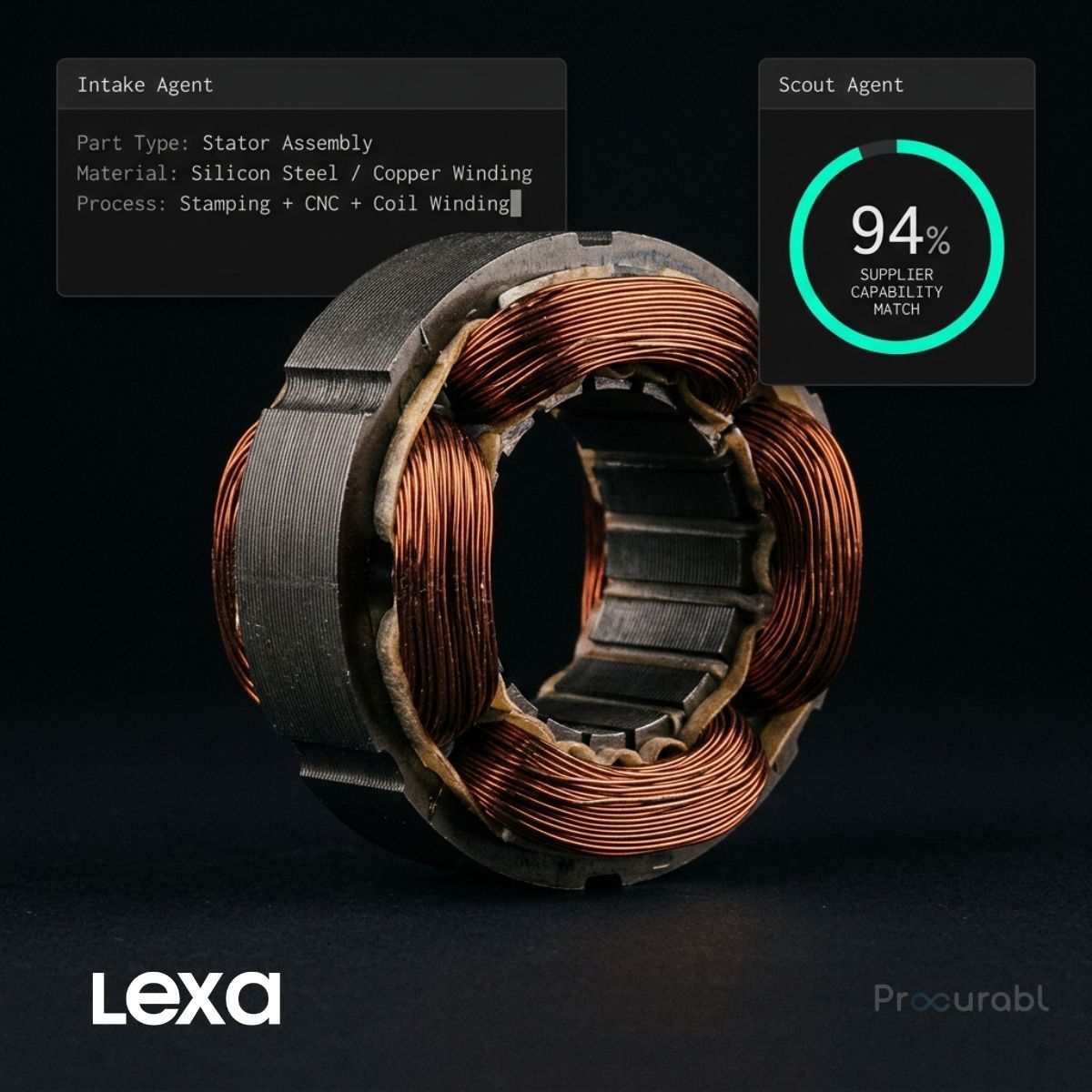
OEM does not see 40 unqualified suppliers competing for an order. They only see a highly curated, limited matched set. The RFQ lands with a supplier because their capability profile matched the requirement exactly.
All this happens within seconds. Yes, from weeks being spent on a single quote, to getting the right one within seconds.
The Reality of AI led Execution
When you stop manually translating engineering data and let the infrastructure route the requirements to verified capabilities, chaos turns into predictable execution. By eliminating the manual friction, Lexa reduces the BOM-to-RFQ cycle time from 14 days to 4 hours.
Procurement teams stop chasing mismatched quotes and start acting strategically. Suppliers stop guessing on incomplete specs and quote exactly what their machines can handle.
Your supply chain shouldn't run on guesswork. It should run on infrastructure.
Want to know about how to manage your BOM? Read this article.