Machine-readable view
The OEM Guide to PCBA Sourcing
2026-06-26T11:39:00.000Z · Procurabl Partner Network
Featured image: Lexa PCBA
Summary: Manual BOM translation causes PCBA delays. Learn how Lexa's embedded AI infrastructure autonomously routes electronics manufacturing to verified capabilities.
Most hardware companies spend months obsessing over product features, firmware coordination, and industrial design. But the moment a complex electronics product moves toward manufacturing, the conversation changes instantly.
Suddenly, the questions aren't about innovation; they are about sheer operational survival. Can production scale without quality dropping? What happens if a critical microcontroller goes End-of-Life (EOL) halfway through the pilot run?
Hardware teams usually don’t think about the mechanics of sourcing until they are already dealing with 40-week lead times and production line freezes. The natural instinct is to blame a fragmented supply chain or complain about global chip shortages.
But here is the unvarnished truth: the delays didn't start at the assembly facility. They started in your own internal workflow.
The Illusion of "Just Assembly"
A lot of companies still treat Printed Circuit Board Assembly (PCBA) as a simple commodity, comparing vendors strictly on price and standard lead times.
But modern hardware, whether it’s a high-voltage EV battery management system or an aerospace sensor array, is incredibly dense. PCBA is never just a pick-and-place operation; it is a highly volatile mix of thermal management, compliance (RoHS, REACH), rigid testing parameters, and massive Bill of Materials (BOM) dependencies.
Take BOM sourcing as an example. A single unallocated integrated circuit (IC) or a specific passives shortage can freeze your entire production line for months. And the frustrating part? It is almost always a tiny standard part that nobody paid attention to during the initial design phase.
Traditional procurement teams spend weeks acting as manual data translators, scrubbing messy PDFs and manually hunting for alternate components across fragmented distributor portals. It is a slow, reactive scramble that bleeds time and capital.
The Quote-to-Spec Gap and Testing Realities
Manufacturing problems often begin during data transfer, not production. When you spray a complex PCBA BOM out to a public job board or a standard vendor directory, suppliers receive an incomplete or mistranslated picture. They quote defensively because they don't have absolute clarity on your testing and compliance constraints.
A board powering on successfully on a bench does not mean the product is reliable at scale. Depending on the critical nature of the hardware, your PCBA requires strict testing protocols:
- Automated Optical Inspection (AOI)
- In-Circuit Testing (ICT)
- X-ray Inspection (for BGA components)
- Burn-in and Thermal Cycling
If your procurement team is manually trying to verify if an overseas facility has the specific X-ray equipment or the AS9100D certifications required for your board, your program is already delayed.
The China+1 Reality for PCBA
There has been a massive strategic shift to diversify electronics manufacturing out of China, with India emerging as a powerhouse for PCBA, especially in EV, Defense, and Industrial IoT sectors.
But executing a China+1 strategy fails if you rely on manual discovery. Finding an EMS provider in India is easy. Verifying that they have real-time API integrations with global semiconductor distributors, the exact surface-mount technology (SMT) lines for your HDI boards, and the capacity to handle your specific lot sizes is an entirely different battle.
You cannot solve an engineering and compliance workflow problem by scrolling through a global vendor directory.
How Lexa Reduces Delay Out of the PCBA Supply Chain
To actually fix electronics sourcing, you have to eliminate the manual data translation bottleneck.
Lexa is a multi agent procurement operating system that completely bypasses the manual discovery phase. We don't act as a middleman; we embed directly into your engineering stack to untangle the data before the supplier ever sees it.
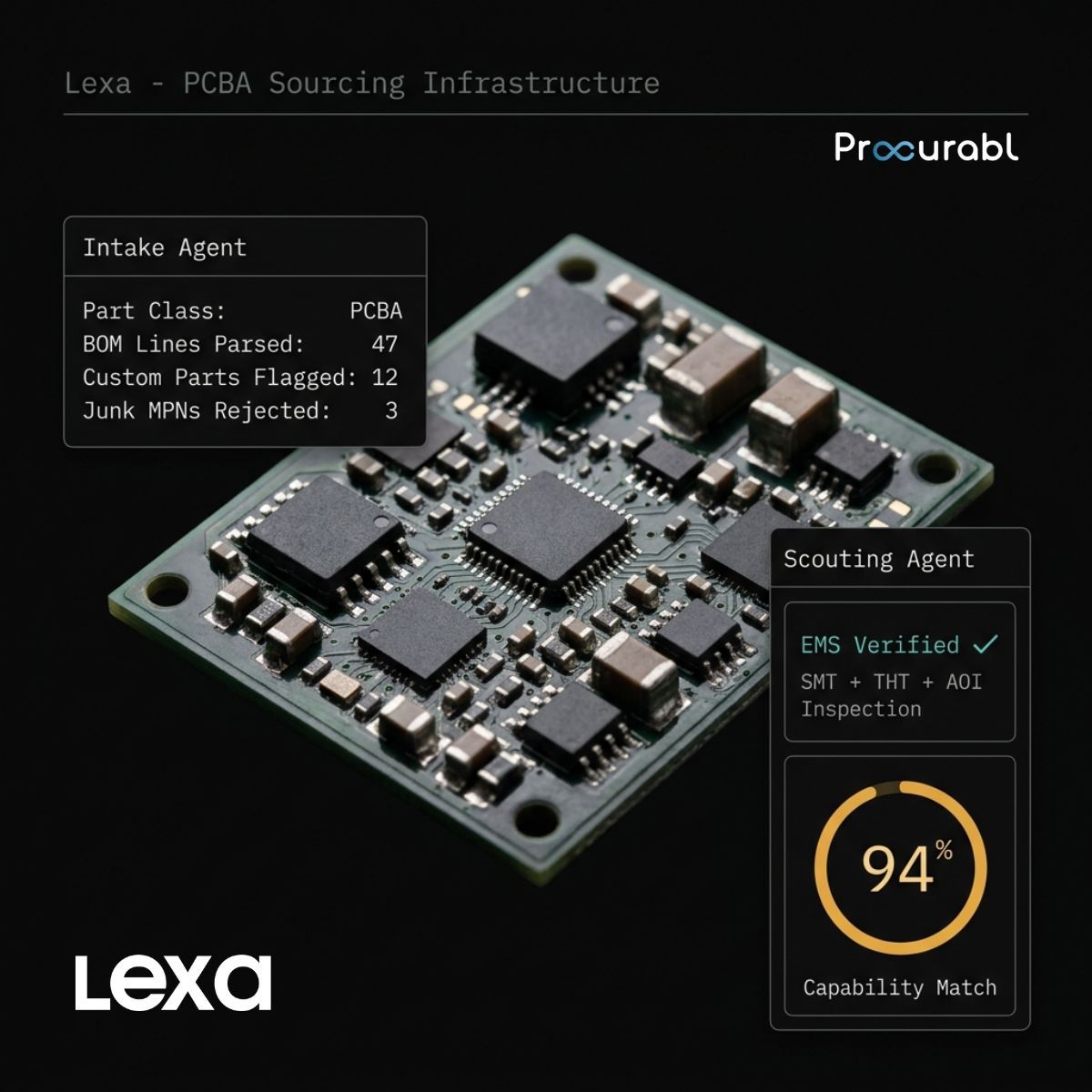
Here is the mechanical reality of how Lexa handles PCBA:
1. Autonomous BOM Intake & Cross-Referencing Lexa catches the BOM the exact second it is dropped from engineering systems like Siemens Teamcenter, SAP, or Arena PLM. Our Intake Agent instantly classifies standard off-the-shelf components versus custom fabricated boards. It natively checks real-time inventory visibility and flags EOL parts across global distributors before an RFQ is ever generated.
2. Instant Capability Matching Instead of broadcasting your proprietary board designs to unqualified bidders, Lexa’s Sourcing Scout scans the deeply verified Lexa Partner Network.
Lexa matches your exact engineering requirements, from IPC-A-610 Class 3 compliance to specific conformal coating capabilities directly against registered facility constraints.
3. Execution Over Discovery The RFQ lands with an EMS provider because their capability profile matched your engineering requirement exactly. Lexa reduces the BOM-to-RFQ cycle time from weeks to just few hours, turning chaotic, one-off sourcing scrambles into predictable, recurring programs.
Your hardware shouldn't rely on guesswork, and your procurement team shouldn't be acting as data entry clerks.
Scale your sourcing capacity across every PCBA program without scaling your headcount. Let Lexa handle the mechanics.