Jul 20, 2026 · Team Lexa
The Hidden Risks of Long-Tail Procurement Consolidation
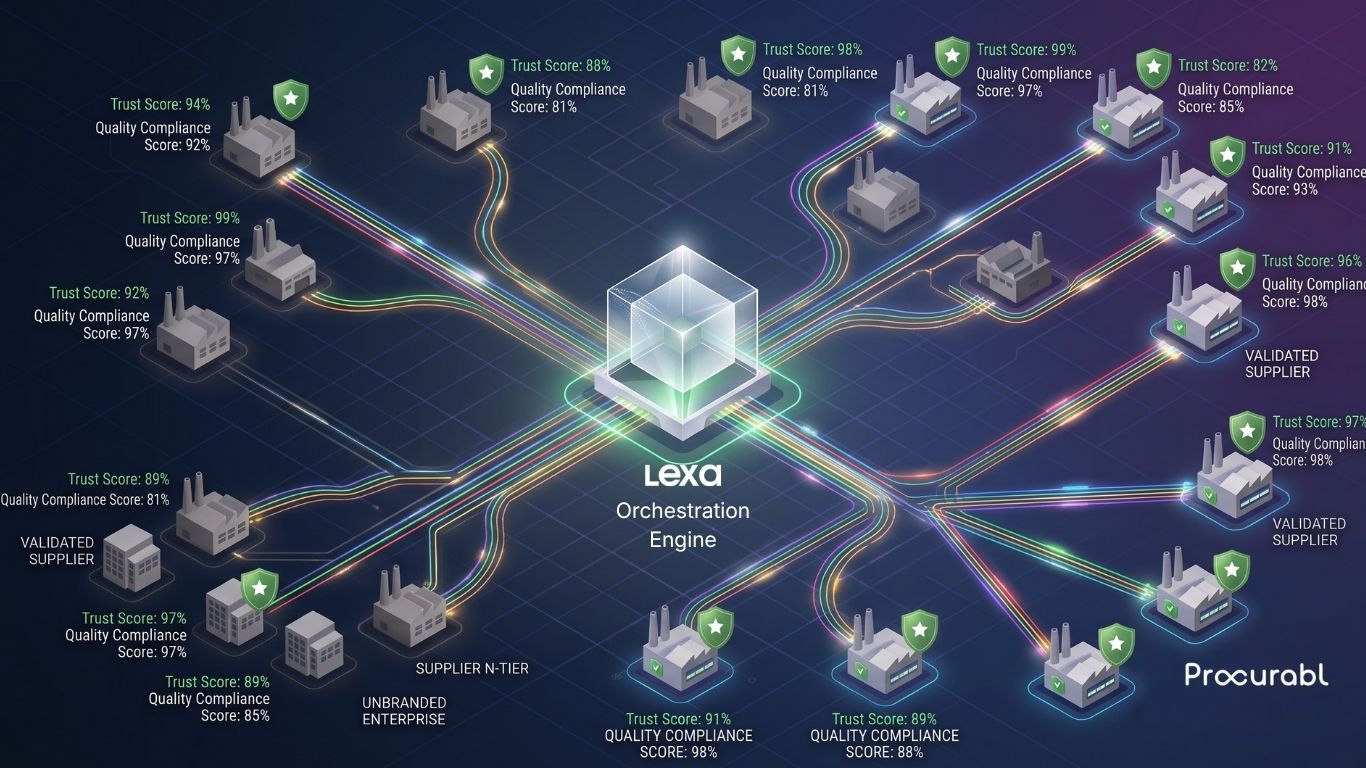
Summary: Outsourcing long-tail procurement can expose your BOM to competitors. Learn how to secure your supply chain IP with orchestration and data isolation.
Consolidated procurement has become a standard offer to OEMs: hand over Category C/D sourcing: the fasteners, gaskets, packaging, and long-tail hardware that are individually cheap but collectively expensive to manage across hundreds of suppliers and a third party will run it, often at no upfront fee. It's a genuinely useful category of service. It's also a category most procurement teams evaluate purely on operational ROI: headcount saved, PO volume reduced, without asking the one question that matters most for anything involving your BOM: who ends up with custody of your sourcing data, and what happens to it next.
How free consolidation actually gets paid for
Most long-tail sourcing consolidation deals follow a similar shape: the vendor takes over sourcing at no retainer, runs it as a pass-through for the first two to three months while trust builds, and then begins "resourcing" - consolidating a supplier base from, say, 100 down to 90, or renegotiating unit pricing using volume leverage no single OEM could generate alone. Whatever cost delta that resourcing produces, the vendor typically takes a meaningful share of the savings; gainshare structures in the 60-70% range aren't unusual.
That economics works cleanly when the leverage comes from a single OEM's own volume. It works even better, from the vendor's side, when supplier volume is pooled across multiple OEM customers on the same commodity supplier, which is the fastest way to generate a bigger resourcing delta. That's sound procurement mechanics in isolation. It becomes something worth real scrutiny when two customers on the same supplier happen to compete, and the parts in question aren't generic hardware but components tied to a specific design, BOM structure, or manufacturing tolerance, the kind of detail that can reveal what a competitor is building, and at what cost, well before it's public.
The supplier fulfilling both orders is aware of whose volume is being combined with whose, because they're the ones doing the fulfilling. The vendor's account team is aware, because pooling is how the savings and their cut of them gets generated. The party least likely to have visibility into any of this is the OEM itself, simply because the entire service is built around removing their line-of-sight into supplier-level detail in the first place.
This isn't a claim that every consolidator mishandles this. It's a structural observation: a gainshare model built on cross-customer resourcing has an economic incentive to pool data, and an OEM evaluating one of these deals on operational ROI alone has no way of seeing whether that incentive is being acted on responsibly in their specific case. That's worth diligencing explicitly, not assuming away.
What good long-tail sourcing consolidation actually requires
The fix isn't avoiding consolidation, the operational case for it is real. It's insisting on a model where data custody stays with the OEM even while the operational weight is handled by someone else. Three things make that possible:
- Direct digital provenance: an auditable record of exactly which supplier is executing which design, at every point, rather than a process that lives inside the vendor's internal account management.
- Contextual data isolation: a supplier receives only what's needed to manufacture its specific component, with no visibility into the broader assembly, and no account team carrying institutional knowledge between competing customers.
- Quantified supplier vetting: visibility into supplier reliability that's scored and auditable, not just relationship-based trust sitting inside the vendor's black book.
This is the standard we built Lexa around. Lexa is a hybrid platform: Procurabl's own managed-services team operates to handling supplier onboarding and warehouse operations, inside a dedicated, per-OEM environment. Every supplier in the ecosystem carries a trust score built from delivery performance, quality history, and compliance record, so consolidation comes with a vetted, ranked supplier base rather than an opaque pool. Payments route through the OEM's own banking partners or through Procurabl's banking and escrow infrastructure via API, staying inside that same isolated environment end to end.
Managed inventory, done the same way
The same custody question applies, arguably more sharply, to managed inventory. Once an OEM's stock sits in a third party's warehouse, that party has visibility into consumption patterns, demand forecasting, and safety stock logic signals that can reveal a production ramp. That's worth the same scrutiny as sourcing data, and it's exactly why Procurabl runs its managed inventory offering: inventory is positioned and released against an OEM's live demand signal inside the same per-account, isolated environment used for sourcing, the working-capital and logistics relief of a fully managed model, with custody staying where it should.
Lexa for Long-Tail Sourcing Consolidation, by Industry
Automotive. Lexa consolidates fasteners, gaskets, trim, and packaging suppliers into a single per-program environment, cutting supplier headcount and PO volume while keeping BOM structure, tolerance data, and supplier cost basis locked to that one vehicle program. Managed inventory through warehouses adds working-capital relief on high-turn C/D components without exposing production ramp data outside the account.
EV. Lexa handles long-tail hardware and packaging consolidation around cell, module, and pack assembly lines, freeing procurement bandwidth for the higher-value cell chemistry and thermal management categories. Isolated managed inventory means consumption data tied to production ramp stays inside the OEM's own environment.
eVTOL. With flight-critical sourcing demanding intense internal scrutiny, Lexa takes the non-critical hardware, fastener, and consumables sourcing off the table entirely, fully managed, fully isolated, freeing the program team to focus supplier oversight where certification actually depends on it.
Aerospace. Lexa consolidates long-tail hardware sourcing with a full digital provenance trail per part, supporting AS9100-aligned traceability requirements. Every supplier carries a buyer trust score built on delivery and quality history, giving procurement teams a vetted, auditable long-tail supplier base.
Defence. Lexa's per-account data isolation and auditable digital thread give defence OEMs a consolidation model built to stand up to export-control and controlled-information compliance requirements; every supplier interaction, every data packet, traceable to a single program.
Infrastructure. Lexa consolidates structural components, MEP hardware, and fasteners into a single managed environment per project or per bidder, cutting supplier sprawl on high-volume tenders while keeping cost-basis data isolated to that specific bid.
Oil & Gas. Lexa manages long-tail consumables, hardware, and MRO sourcing tied to field operations, with a warehouse network providing managed inventory positioning close to remote sites.
Consumer Durables (FMCD). Lexa consolidates high-SKU-count, high-supplier-count categories, packaging, hardware, plastics, fasteners, typical of consumer durables BOMs, with managed inventory through warehouses smoothing seasonal demand swings.
What to look for in a long-tail sourcing consolidation partner
Before signing any consolidated-procurement or gainshare-based sourcing or inventory deal, these are worth asking any vendor:
Q: Which other customers does this vendor serve in overlapping categories, and are any of them direct competitors? A dedicated account structure is the standard to expect, not a shared team working across competing customers' books.
Q: Is there a contractual, auditable data wall between accounts on shared suppliers? Look for contextual data isolation, where a supplier only sees what's needed to manufacture its specific component, not visibility into your broader assembly or roadmap.
Q: How are suppliers in the network vetted, and can that be quantified? A scored, auditable trust rating beats relationship-based assurance every time, you should be able to see why a supplier is trusted, not just that they are.
Q: Who has visibility into consumption and demand data once inventory sits in a third-party warehouse? Inventory should be positioned and released against your own demand signal, inside a per-account isolated environment, not visible to whoever else the operator is warehousing for.
Q: Does payment route through a shared treasury operation, or stay inside your own environment? You should have the option to route through your own banking partners or the vendor's, via API, with either path staying isolated to your account.
Q: Is there an auditable record of which supplier executed which design? Full digital provenance, end to end, should be table stakes, not a feature you have to ask for separately.
None of these questions get asked often enough today, because long-tail sourcing consolidation tends to get evaluated purely as a cost centre handed off, rather than as a decision about who holds custody of your sourcing data.
Inside the Lexa ecosystem
The diligence questions above aren't hypothetical for us, they're close to the actual product. A few things worth knowing about how Lexa is built, beyond the isolation model:
Supplier classification runs deep, not just wide. Every supplier onboarded into Lexa is placed against a five-level classification system, cross-referenced automatically at RFQ time; so an OEM isn't just getting a bigger supplier pool, it's getting the right supplier surfaced for the right part, at the right quality tier, without a human account manager making that judgment call from memory.
Quality gates are structured, not tribal knowledge. Lexa's supplier configurator runs against a quality-gates dataset spanning manufacturing process types, so vetting isn't a black book of relationships an account manager keeps in their head, it's a structured, query-able standard applied consistently across every supplier in the network.
Working capital is part of the offer, not a separate negotiation. OEMs and suppliers on Lexa can access working capital financing and escrow-backed payment flows through Procurabl's banking partners, so the same isolation principles that apply to sourcing and inventory data extend to how money actually moves through the account.
The best way to evaluate procurement governance isn't through a sales deck, it's by seeing the product. If you're curious how Lexa isolates customer workspaces, structures supplier intelligence, and protects procurement data by design, book a demo or try the platform.