Machine-readable view
Sourcing Carbon Fiber UAV/Drone Chassis for Scale Production
2026-07-10T04:30:00.000Z · Procurabl Partner Network
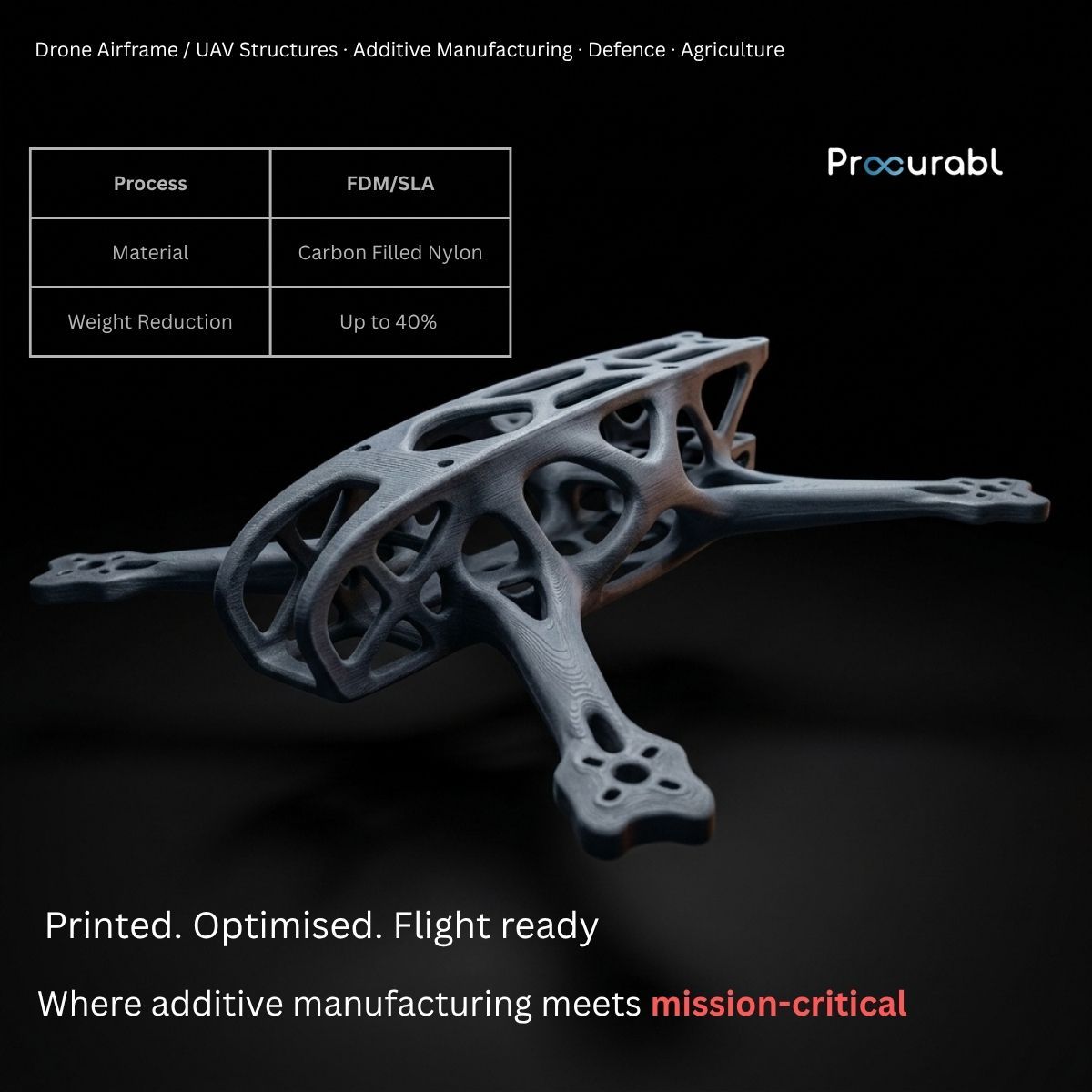
Featured image: 3D printed Drone/UAV Frame
Summary: Sourcing a high-performance FPV drone frame isn't about finding a basic job shop; it's about translating topological design constraints into scalable aerospace manufacturing. Lexa’s embedded AI solves this, autonomously routing complex carbon fiber drone and advanced Carbon Filled Nylon requirements to a comprehensively verified partner network in hours, not weeks.
Everyone in the aerospace, defense, and commercial UAV space is chasing the exact same metric: maximum flight time through extreme weight reduction.
To achieve this, engineering teams are abandoning traditional, heavy structural components in favor of advanced additive manufacturing (utilizing FDM/SLA for complex geometries) and rigid, lightweight composite plates. By optimizing materials like Carbon Filled Nylon, engineers are successfully achieving up to a 40% weight reduction.
But here is the reality nobody talks about: transitioning a mission-critical drone frame from an optimized CAD file to scalable, repeatable production usually fails at the procurement data layer.
The Traditional Directory Failure
The traditional approach to sourcing a complex long range drone frame relies on manual discovery and brute-force communication. Procurement teams take a generatively designed CAD file or a dense multi-level bill of materials (BOM) and blast RFQs across public supplier directories, hoping to find a facility that can actually build it.
When you execute procurement this way, chaos ensues. You end up with quotes from unverified hobbyist shops or generic plastic brokers that lack industrial-grade infrastructure. They do not have the environmental controls required to prevent moisture absorption in nylon, nor the quality control frameworks required to handle aerospace-grade advanced composites.
The program gets delayed by weeks just trying to validate if a supplier's machine bed size can handle your frame dimensions, or if their quality systems can actually hold your required tolerances.
The barrier to scaling a UAV program isn't finding a factory. It is the friction of translating your precise material specifications and complex geometry for a heavily fragmented manufacturing market.
Sourcing the Material & Variant Nuance
Standard procurement platforms fail because they treat all drone components as commodity plastics or basic metal brackets. A mission-critical UAV requires highly specific material behaviors, which means sourcing from facilities with validated, specialized constraints:
- Carbon Fiber Drone Components: Offers the ultimate tensile strength and rigidity for structural arms, preventing flexing during violent maneuvers. Sourcing this requires precision CNC routing or waterjet cutting of high-grade carbon fiber sheets. If the supplier lacks the specific feed-rate expertise for composites, they will cause microscopic delamination and fiber fraying, leading to catastrophic mid-air failure.
- Carbon Filled Nylon Shapes (FDM/SLA): Perfect for complex, aerodynamically optimized centre pods, canopies, and internal brackets. This requires industrial-grade additive manufacturing to ensure isotropic strength and flawless layer adhesion across the entire Z-axis.
- Application Constraints: Whether matching the impact resistance needed for a racing drone frame, the extreme light weighting for a long range drone frame, or the specific vibration-dampening harmonics required for a cinewhoop frame, a manual directory cannot map these nuances. Lexa’s multi-agent OS knows exactly which manufacturing process fits the engineering intent.
Engineering Risk Out of the System
To actually execute autonomous sourcing and scale UAV production, you need load-bearing procurement infrastructure.
This is why Lexa exists. Lexa is an embedded procurement system that completely bypasses the manual discovery phase. Instead of forcing procurement teams to hunt for capable facilities, Lexa intercepts the workflow inside your existing engineering stack.
Here is how Lexa makes sourcing autonomous:
- Intake Agent: Lexa catches your complex 3D models and engineering data the exact second they are released from platforms like Siemens Teamcenter, SAP, or Arena PLM.
- Instant Classification & Parsing: Our AI autonomously reads the engineering intent. It extracts the exact material specs, whether it calls for carbon fiber machining or Carbon Filled Nylon 3D printing, maps the geometric tolerances, and identifies the required certifications.
- Sourcing Scout: Instead of broadcasting to a public board, Lexa’s Sourcing Scout scans the deeply verified Lexa Partner Network. The RFQ is routed exclusively to industrial facilities whose registered machine constraints, additive manufacturing bandwidth, and active ISO/AS certifications exactly match your parsed engineering requirements.
- Order Auditor: Moving from prototype to production requires absolute compliance. For both CNC-machined carbon fiber plates and 3D-printed composite structures, Order Auditor tracks every milestone your team defines; FAI, PPAP, QC inspection, X-ray records (for carbon delamination or 3D print layer voids), material certifications, NADCAP compliance, shipping, customs clearance, and final landed cost.
When a milestone is at risk, it flags it before the delay becomes a program problem. Your team steps in only when a decision needs a human. Every document, every checkpoint, stored in a single data master. So when your customer or regulator asks, everything is already there.
Move your UAV programs faster, eliminate vendor guesswork, and let Lexa handle the mechanics. Where advanced manufacturing meets mission-critical defence and commercial applications, Lexa delivers.
Common Sourcing Questions
How does Lexa ensure manufacturers can accurately machine rigid carbon fiber drone plates without structural defects?
Lexa’s Intake Agent parses your edge tolerances and hole placement dimensions directly from the CAD data. The Sourcing Scout then matches those parameters exclusively with suppliers in the Lexa Partner Network who possess high-speed CNC routing or precision waterjet machinery calibrated specifically for composite plates, preventing delamination or fiber fraying.
What is the process for verifying raw material traceability for Carbon Filled Nylon or carbon fiber sheets?
Suppliers in our verified network undergo rigorous compliance audits. The platform automatically tracks and verifies raw material certificates (MTRs), ensuring that the advanced composites used in your drone chassis meet the exact tensile strength, density, and defence-grade standards specified by your design team before any production begins.
Can Lexa handle multi-process BOMs that combine 3D printing, CNC machining, and hardware injection molding?
Yes. Lexa bypasses single-process catalog limitations. Our multi-agent OS parses multi-level BOMs instantly, separating the flat carbon fiber plates, the topology-optimized 3D printed components, and the off-the-shelf fasteners, routing each sub-component to the exact right specialized hub within the Lexa Partner Network simultaneously.
How does Procurabl’s Managed Services support UAV scaling?
When procurement volume outpaces internal headcount, Procurabl's Managed Services deploys dedicated experts to take over the physical execution. Rather than just offering software routing, Procurabl acts as your tactical buyer, managing the RFQ negotiations, overseeing cross-border logistics, and enforcing supplier corrective actions on the ground, allowing your engineering team to stay focused on product development.