Machine-readable view
Reality of China+1: Why Vendor Directories Fail and Lexa Wins
2026-06-26T00:00:00.000Z · Ninad Kashid
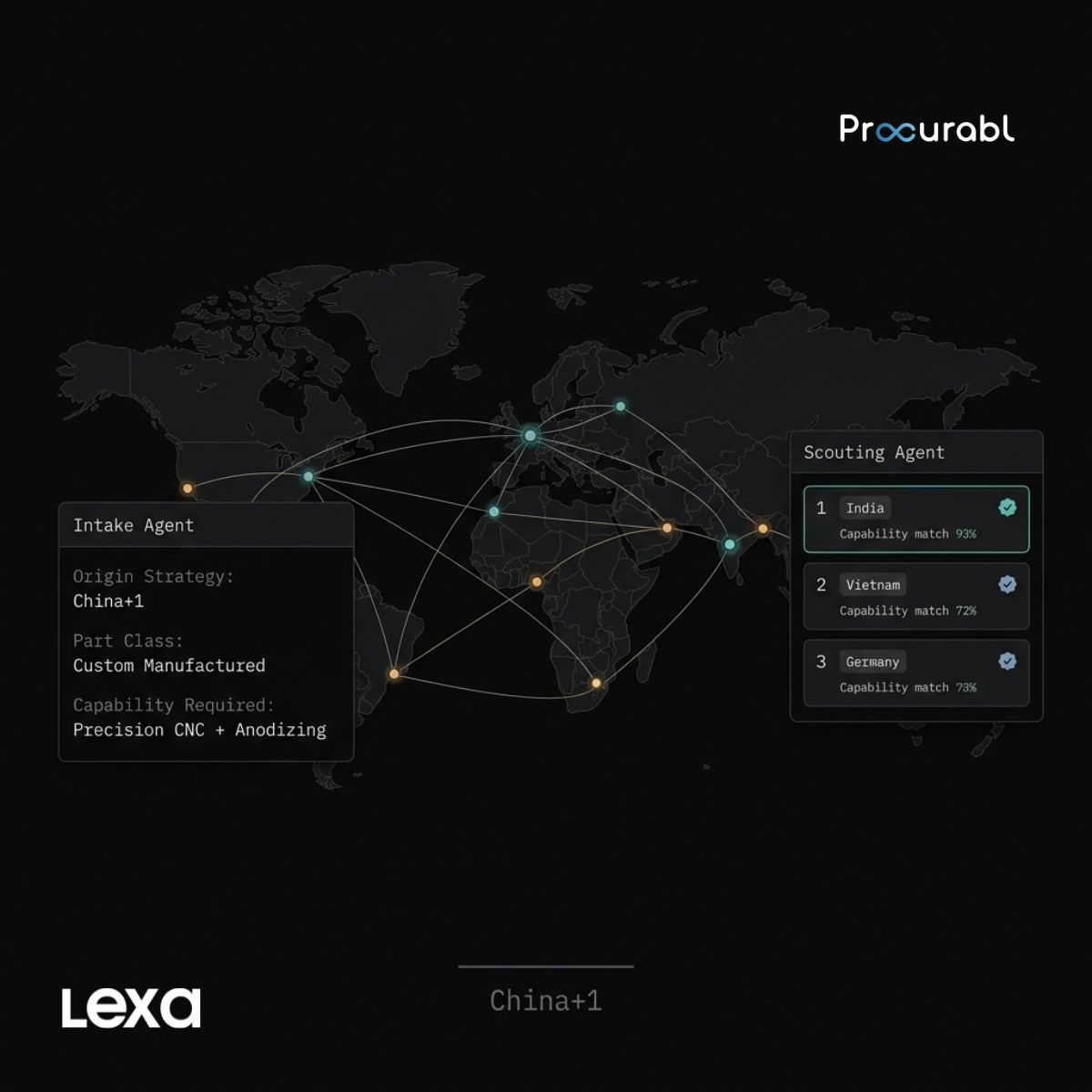
Featured image: China+1 with Lexa Partner Network
Summary: The real bottleneck in China+1 diversification is manual data translation. Lexa’s embedded AI solves this, autonomously routing complex engineering requirements to a comprehensively verified partner network in hours, not weeks.
Everyone in the supply chain space is talking about the China+1 strategy. If you are building the next generation of EV drivetrains, robotics, or aerospace components, diversifying your supply chain out of China is no longer optional. It is a mandate for survival.
India has rapidly become the prime destination for this shift, boasting incredible manufacturing capabilities, competitive costs, and deep engineering talent.
But here is the reality nobody talks about: Executing a China+1 strategy usually fails at the data layer.
The Execution Bottleneck
The traditional approach to geographical diversification relies on discovery. Procurement teams take a massive, unoptimized Bill of Materials (BOM), act as manual data translators, and blast RFQs across new regions hoping to find an Indian factory that can build the part.
When you do this, chaos ensues. You end up with quotes from unverified facilities that don't have the specific 5-axis CNC machines, the necessary AS9100D compliance, or IATF 16949 certification or the actual machine capability to hold your required tolerances. The program gets delayed by weeks just trying to validate if a supplier is real.
The barrier to China+1 isn't finding a factory. It is the friction of translating your engineering data for a fragmented market. You cannot solve a complex engineering workflow problem with a global supplier directory.
Engineering Risk Out of the System
To actually execute diversification, you need load-bearing infrastructure.
This is why we built Lexa. Lexa is an embedded procurement system that completely bypasses the manual discovery phase. Instead of forcing procurement teams to hunt for capable suppliers in India, Lexa intercepts the workflow inside your existing engineering stack.
Here is how Lexa makes China+1 autonomous:
- Intake Agent: Lexa catches your BOM the exact second it is released from engineering systems like Siemens Teamcenter, SAP, or Arena PLM. No manual uploads. No messy email threads to overseas brokers.
- Instant Classification & Parsing: Our intake agent autonomously classifies custom parts and reads the exact material, tolerance, and compliance requirements (ITAR, REACH, RoHS) & traceability.
- Sourcing Scout: Instead of broadcasting to a public job board, Lexa’s Sourcing Scout scans a deeply verified network of Indian manufacturers. The RFQ is routed exclusively to facilities whose registered machine constraints and certifications exactly match your parsed engineering requirements.
Infrastructure Over Guesswork
Executing China+1 autonomously only works if the physical capacity exists to back it up. That is why we built the Lexa Partner Network, a deeply verified ecosystem that covers every manufacturing capability in the market.
Instead of dealing with the operational overhead of fragmented sourcing, Lexa routes your designs directly into this network. We reduce the BOM-to-RFQ cycle time from 14+ days to 4 hours, mapping complex requirements to validated constraints across Aerospace, Automotive, Robotics, and Defence.
You don't need a platform that "connects" you to suppliers. You need a multi-agent operating system that executes your supply chain strategy in the background. Move your programs faster, build inherent resilience, and let Lexa handle the mechanics.