Machine-readable view
How to Source Power Cables and HV Cables for a Battery Energy Storage System
2026-07-08T17:00:00.000Z · Procurabl Partner Network
Featured image: Procurabl Lexa Sourcing Guide
Summary: The real bottleneck in scaling a Battery Energy Storage System isn't just material availability; it is the manual translation of complex thermal and electrical constraints. Lexa’s embedded AI solves this, autonomously routing exact power cable and HV cable requirements to a comprehensively verified partner network in hours, not weeks.
Everyone in the renewable energy space knows that grid-scale deployments are expanding rapidly. To handle higher storage capacities and reduce structural weight, engineering teams are demanding high-amp, high-purity aluminium conductors.
But here is the reality nobody talks about: executing a resilient supply chain for these critical components usually fails at the data layer.
The Execution Bottleneck
The traditional approach to sourcing infrastructure for a Battery Energy Storage System relies on manual discovery. Procurement teams take a massive, unoptimized Bill of Materials (BOM) specifying XLPE insulation, exact cross-sectional sizing for I²R loss minimization, and specific thermal endurance limits and blast RFQs across global vendor directories.
When you do this, chaos ensues. You end up with quotes from unverified facilities that lack the specific precision stranding equipment or the quality control required for high-purity extrusion. The project gets delayed by weeks just trying to validate if a supplier's testing actually aligns with your containerized environment.
The barrier isn't finding a cable manufacturer. It is the friction of translating your precise thermal dynamics, derating factors, and voltage requirements for a fragmented market. You cannot solve a complex engineering workflow problem with a basic supplier directory.
Power Cables vs. HV Cables: Sourcing the Difference
Standard procurement platforms fail because they treat all wire as a commodity. A utility-scale Battery Energy Storage System requires two entirely different electrical architectures, which means sourcing from entirely different manufacturing capabilities:
- Power Cables (The DC Side): These are the heavy-duty cables that connect internal battery modules and route DC power to the inverters. They are designed to carry massive current (amperage) and operate up to 1500V DC. They require specific flexibility for tight routing inside battery enclosures.
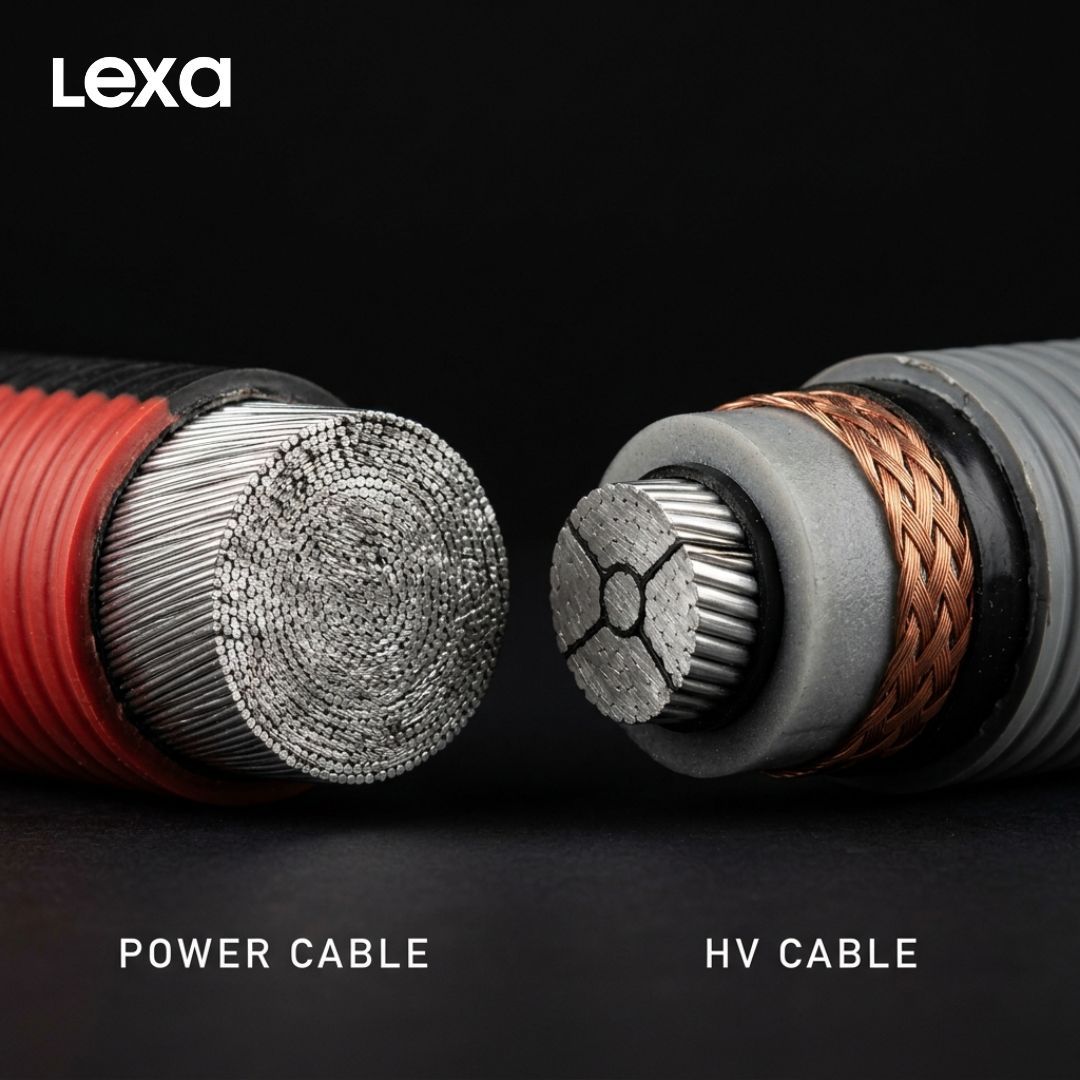
- HV Cables (The AC Side): Once the inverter converts the power, transformers step it up to massive voltages (33kV, 66kV, or higher) for the national grid. Sourcing these true High Voltage (HV) cables requires manufacturers with completely different dielectric testing facilities and grid-compliance certifications.
Engineering Risk Out of the System
To actually scale a Battery Energy Storage System, you need load-bearing procurement infrastructure.
This is why Lexa exists. Lexa is an embedded procurement system that completely bypasses the manual discovery phase. Instead of forcing procurement teams to hunt for capable extrusion facilities, Lexa intercepts the workflow inside your existing engineering stack.
Here is how Lexa makes sourcing autonomous:
- Intake Agent: Lexa catches your cable specifications the exact second they are released from engineering systems like Siemens Teamcenter, SAP, or Arena PLM. No manual uploads. No messy email threads to overseas brokers.
- Instant Classification & Parsing: Our AI autonomously reads the exact engineering intent. Whether the BOM calls for heavy-duty DC power cables to handle 1500V internal battery routing, or grid-scale HV cables to connect the inverters to the substation, Lexa extracts the exact thermal class, strand compaction, and insulation limits.
- Sourcing Scout: Instead of broadcasting to a public job board, Lexa’s Sourcing Scout scans a deeply verified network of manufacturers. The RFQ is routed exclusively to facilities whose registered machine constraints, extrusion bandwidth, and ISO-aligned quality systems exactly match your parsed electrical and thermal requirements.
Infrastructure Over Guesswork
Executing a fast, resilient supply chain only works if the physical capacity exists to back it up. We reduce the BOM-to-RFQ cycle time for complex cables from 30+ days to 4 hours, mapping complex requirements to validated constraints.
You don't need a platform that "connects" you to suppliers. You need a multi-agent operating system that executes your supply chain strategy in the background. Move your programs faster, build inherent resilience, and let Lexa handle the mechanics
Common Sourcing Questions
How does Lexa ensure manufacturers can meet specific thermal derating requirements for a Battery Energy Storage System?
Lexa’s Intake Agent parses your exact ambient temperature and grouping conditions directly from your engineering data. The Sourcing Scout then matches those parameters exclusively with suppliers who have validated testing capabilities for cyclic thermal stress and high-temperature environments.
What is the process for verifying the quality of Power Cables and HV Cables?
Suppliers in the Lexa Partner Network undergo comprehensive compliance audits. The platform automatically verifies active ISO certifications, traces high-purity aluminium supply lines, and cross-references a facility's capability to produce XLPE insulation that meets emergency overload and short-circuit withstand standards for both DC and AC applications.
Can Lexa handle the sourcing of custom cable cross-sections and precision stranding?
Yes. Lexa bypasses standard catalog limitations. By intercepting the BOM at the engineering level, our AI reads custom strand geometry and compaction ratios, instantly routing the requirement to facilities with the exact tooling and extrusion capacity required to manufacture it.
How does automated sourcing reduce lead times for critical energy storage components?
Manual sourcing relies on sequential communication and guesswork, which often results in 12 to 16-week lead times for specialized cables. Lexa's multi-agent OS maps real-time machine availability across our verified network, routing your BOM instantly to facilities with active bandwidth, cutting discovery and validation down to hours.
What if our team requires fully managed support to source Battery Energy Storage System cables?
While Lexa provides the autonomous data and routing layer, complex capital projects often require hands-on supply chain execution. If your organization needs dedicated oversight, Procurabl’s Managed Services provides end-to-end support. Our procurement experts step in to manage the entire lifecycle; from navigating the complex manufacturing constraints of Power Cables and HV Cables, to supplier negotiation and final execution ensuring your infrastructure scales without adding operational overhead to your team.