Machine-readable view
BOM Management 101: The OEM’s Guide to Standard and Custom Parts
2026-06-22T05:11:00.000Z · Ninad Kashid
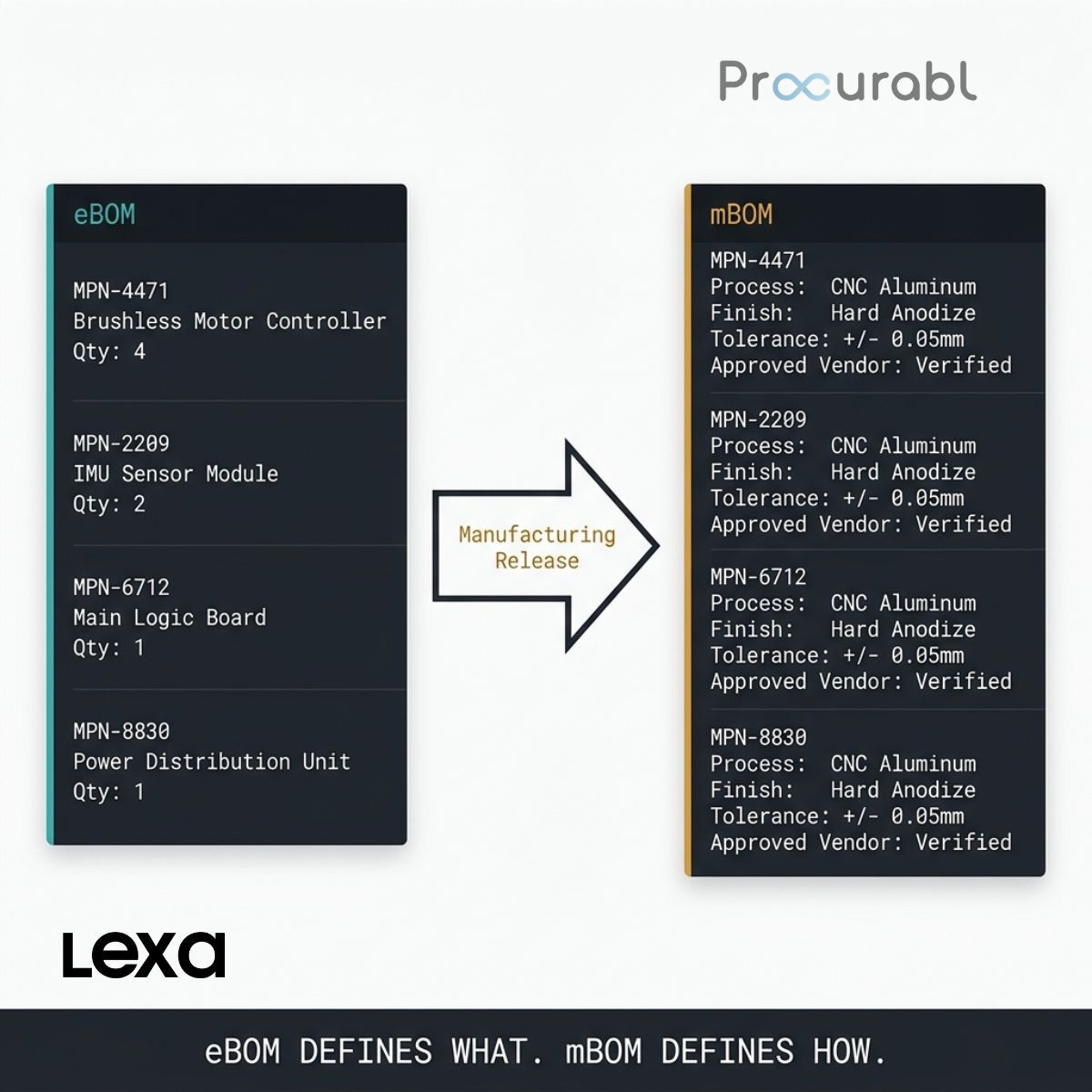
Featured image: eBOM to mBOM
Summary: Learn the fundamentals of BOM management for hardware OEMs. Discover how to structure eBOMs and mBOMs, and how Lexa automates BOM intake to reduce sourcing delays
Hardware engineering never stands still. Whether you are scaling a robotics platform, designing an 800V EV drivetrain, or launching an aerospace sensor array, design cycles are shrinking while mechanical complexity is exploding.
In this high-velocity environment, the Bill of Materials (BOM) sits at the exact center of your operations.
A BOM is not just a parts list. It is the absolute DNA of your product. It is the single document that bridges the gap between engineering intent and physical manufacturing. When managed well, it ensures predictable supply chains and rapid time-to-market. When managed poorly, relying on static spreadsheets and manual data entry, it creates chaos, expensive rework, and massive launch delays.
For modern Original Equipment Manufacturers (OEMs), BOM management is no longer just an administrative task. It is a critical engineering workflow. Here is the unvarnished truth about managing complex Bills of Materials, and why enterprise hardware teams are abandoning manual processes for embedded procurement infrastructure.
What is a Bill of Materials (BOM)?
At its core, a Bill of Materials (BOM) is a comprehensive, hierarchical list of the raw materials, standard components, custom manufactured parts, and sub-assemblies required to manufacture a finished product.
While Product Lifecycle Management (PLM) systems define how a product works in theory, the BOM defines exactly what is required to build it in reality. Engineering relies on the BOM for design validation; procurement relies on it for sourcing; and manufacturing relies on it for assembly.
For modern hardware, a BOM is uniquely complex because it must unify two entirely different supply chains:
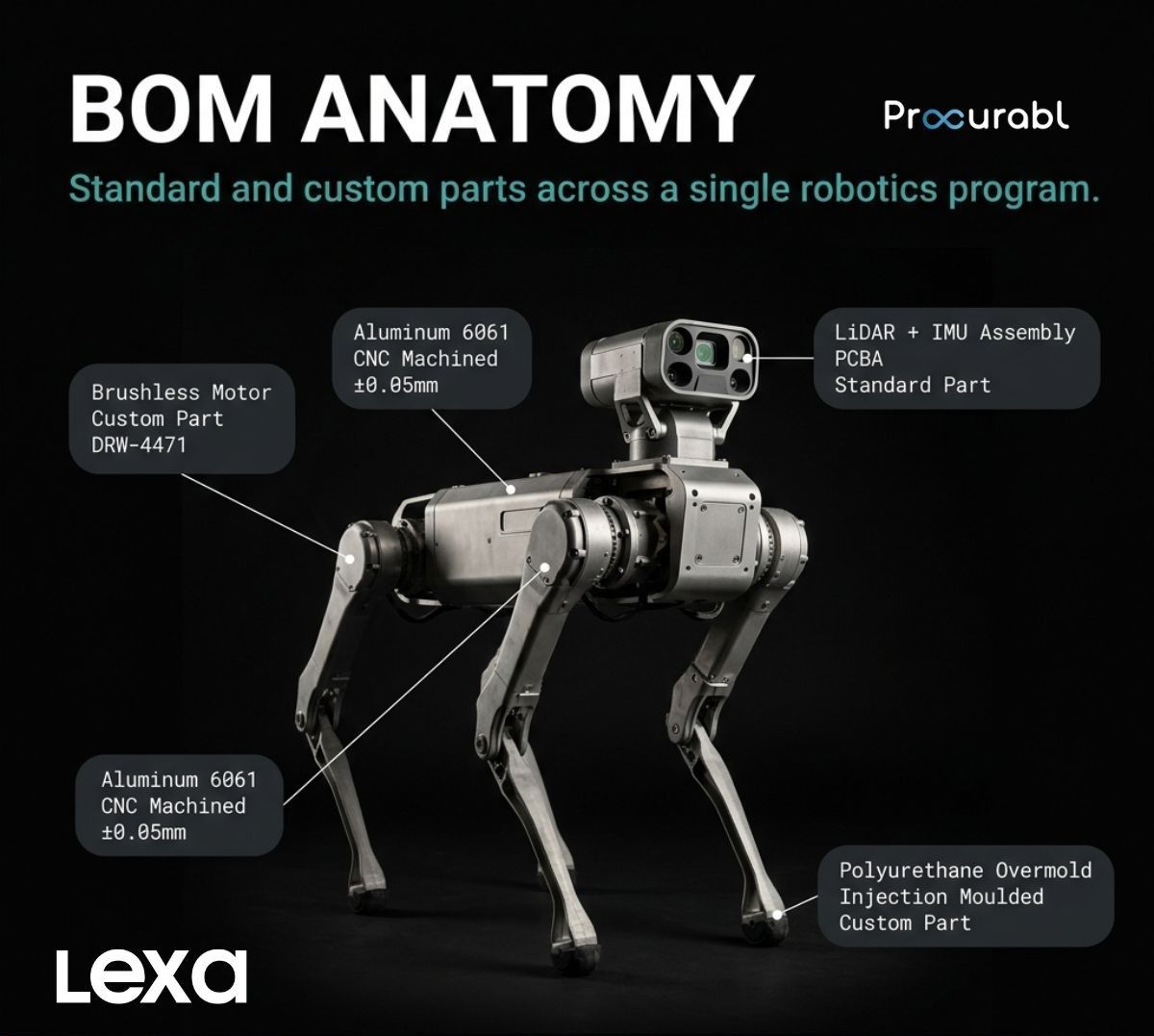
- Standard Parts (COTS): Electronic components (resistors, high-voltage capacitors, ICs), fasteners, and connectors. These require tracking Manufacturer Part Numbers (MPNs), End-of-Life (EOL) statuses, and global distributor inventory.
- Custom Parts: Chassis, enclosures, and motor stators. These require 3/5-axis CNC machining, sheet metal fabrication, or injection molding. They do not have MPNs; they are defined by rigid CAD geometries, specific material grades, tolerances, and surface finishes.
A mismanaged BOM that fails to accurately capture the data for both standard and custom parts will inevitably paralyze a production line.
Why BOM Management is Critical for Hardware OEMs
Managing a BOM for a high-tech hardware product is notoriously difficult. If you rely on procurement teams to act as manual data translators between engineering and suppliers, the system will break down. Here is why BOM management is so critical:
- The Data Translation Bottleneck: Procurement teams typically spend 80% of their time managing data and only 20% actually building supply chain resilience. They are forced to decipher missing tolerances, incomplete specs, and messy PDFs across siloed systems before they can even issue an RFQ.
- Extreme Component Volatility: Standard electronic parts face severe market fluctuations. A multilayer ceramic capacitor (MLCC) available today might go obsolete or hit a 40-week lead time tomorrow. If your BOM is static, you won't know until the assembly line stops.
- Strict Compliance Standards: Modern hardware must adhere to ITAR, RoHS, REACH, or NADCAP standards. Proving that every single line item meets these regulations requires part-level mapping built directly into the BOM workflow.
The Evolution of the BOM: eBOM, mBOM, and pBOM
As a hardware product moves from a concept in an engineer's mind to a physical object on the factory floor, the BOM evolves. Understanding the different states of a BOM is essential for cross-functional alignment.
1. The Engineering BOM (eBOM) The eBOM is the designer's blueprint. Created by engineering in CAD or EDA software, it reflects the product as it was designed functionally. It lists all the necessary components, custom geometries, and reference designators. However, it does not account for how the product will actually be assembled on the shop floor.
2. The Manufacturing BOM (mBOM) The mBOM is the production roadmap. It takes the eBOM and adapts it for the physical realities of the factory. It includes all the original parts but adds consumables (adhesives, solder, thermal paste), packaging materials, and specific sub-assembly routing instructions for the contract manufacturer.
3. The Production BOM (pBOM) The pBOM is the master execution list utilized by ERP systems. It is often a "flattened" version of the mBOM, optimized purely for Material Requirements Planning (MRP). It strips away the hierarchical sub-assembly layers to give procurement a direct, line-by-line list of what must be purchased and inventoried.
Structuring a Best-Practice BOM
Because modern OEMs build products that marry heavy mechanical assemblies with advanced electronics, a best-practice BOM must capture data for both custom and standard parts in a unified format.
At a minimum, your BOM structure should capture these critical data points:
- Item / Level ID: Establishes the hierarchical parent/child relationship of sub-assemblies.
- Part Classification: Delineates whether the item is a Standard off-the-shelf part or a Custom Fabricated part.
- Manufacturer Part Number (MPN): The exact global identifier required to source electronic and standard components.
- Reference Designator: Links the standard part to its exact location on the PCB schematic (e.g., R1, C4).
- Manufacturing Process: For custom parts, this defines the required machine capability (e.g., 5-Axis CNC Milling, Sheet Metal Bending).
- Material Grade: Specifies the exact raw material required for custom fabrication (e.g., Aluminum 6061-T6, PEEK).
- Tolerances & Finish: Details the mechanical precision and surface treatments (e.g., Anodizing, Powder Coating).
- Compliance & Certs: Hard-blocks non-compliant sourcing by listing required standards (e.g., RoHS, AS9120, REACH).
The Legacy Problem: Why Spreadsheets Fail
Despite the staggering complexity of high-velocity hardware, many OEMs still attempt to manage BOMs using static Excel spreadsheets.
This approach is fundamentally broken. Spreadsheets lack real-time visibility. If an IC goes End-of-Life, or a global shortage hits a specific grade of aluminium, a static spreadsheet will not warn you.
When a BOM is locked in a spreadsheet, version control becomes a nightmare. Procurement might be quoting from "BOM_v2_Final.xlsx" while engineering has already moved on to "BOM_v3_Updated." By the time the miscommunication is caught, the wrong parts have already been ordered, bleeding capital and killing launch schedules.
Lexa: Turning the BOM into Automated Infrastructure
To eliminate procurement delays and eradicate the data translation bottleneck, your BOM needs to be connected to the real world.
Lexa is an embedded, multi-agent operating system designed to execute your supply chain strategy autonomously. We turn your static BOMs into active infrastructure.
Here is how Lexa transforms BOM management:
- Autonomous BOM Intake: Lexa embeds directly into your existing engineering stack. The exact second a BOM is dropped from systems like Siemens Teamcenter, SAP, or Arena PLM, Lexa’s Intake Agent catches it. There are no manual spreadsheet uploads and no data lost in translation.
- Instant Classification and Parsing: Lexa autonomously classifies every single line item. For standard parts, it instantly cross-references MPNs against global distributor APIs, flagging EOL risks before an RFQ is ever generated. For custom parts, it parses the exact manufacturing process, material, and tolerances natively.
- Precision Capability Matching: Once the BOM is parsed, Lexa’s Sourcing Scout routes the requirements exclusively to verified suppliers whose registered machine constraints and certifications exactly match your engineering data.
By replacing manual spreadsheet management with AI-native orchestration, Lexa reduces the BOM-to-RFQ cycle time from weeks to hours. Procurement teams stop chasing bad data and start acting strategically.
Your supply chain shouldn't run on guesswork and manual spreadsheets. It should run on infrastructure.