Aug 22, 2026 · Team Lexa
Agentic Procurement for Electronics
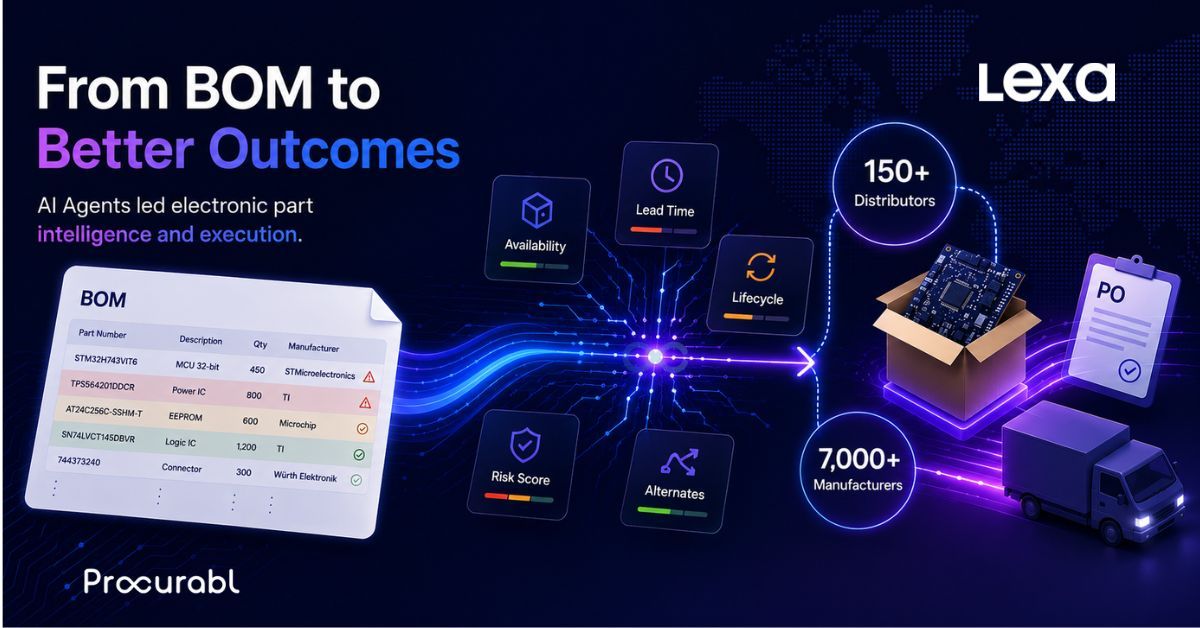
Electronic component sourcing fails when BOM data is scattered across inboxes, spreadsheets, and datasheets. Upload your BOM to Lexa, see the sourcing risk on every line, and buy the parts you need - quoted, sourced, and delivered through Procurabl.
Every electronic product starts with the same set of decisions, repeated hundreds or thousands of times: which part to use, where to source it, whether it will be available when needed, what it will cost, and whether the supplier can actually deliver.
Those decisions rarely live in one place.
Specifications sit in datasheets. Supplier pricing arrives in spreadsheets and PDF quotes. Lead times shift without notice. Engineering evaluates alternate parts separately from procurement. Purchase orders move through the ERP while the real conversation, the one that matters, is still happening in email threads no one else can see.
The result: teams have no shortage of information about their BOM. What they lack is a fast, reliable answer to the only question that matters - what should we do about this part, right now?
That's the gap Lexa is built to close. Upload a BOM at procurabl.com/lexa→, see the sourcing risk on every line item, and get the parts quoted and sourced through Procurabl. No sales call required to see where you stand.
Electronics Procurement Has a Knowledge Problem
A single BOM can carry hundreds or thousands of line items. Each one carries its own manufacturers, distributors, lifecycle stage, pricing structure, lead time, compliance requirement, and possible alternates. And every one of those attributes keeps moving.
A part that was in stock last quarter may now show a 16-week lead time. A quote may have expired. A manufacturer may have quietly announced an end-of-life transition. A previously approved substitute may no longer meet spec.
Procurement teams are expected to track all of this by hand, on top of running day-to-day purchasing.
Adding headcount doesn't fix this. If the underlying BOM data is still fragmented across five systems, more people just means more handoffs, more spreadsheets, and more places for information to go stale before anyone acts on it.
The real problem isn't volume. It's turning fragmented BOM data into a decision, fast enough to matter.
What "AI Procurement" Should Actually Mean for a BOM
Most procurement software is good at recording transactions: a PO was cut, a supplier was selected, an order is scheduled. That's necessary, but it isn't intelligence.
Take a single component on your BOM. Knowing its price is useful. Knowing its lead time is 16 weeks is useful. Knowing which distributors have stock is useful. None of that answers the actual question:
Is this price movement significant enough to act on? Will this lead time threaten the build schedule? Is there an approved substitute? Should engineering see this before the design freezes?
This is the gap between information retrieval and decision support, and it's the gap Lexa's matching and sourcing engine is built to close. Instead of returning a list of parts that technically match a search term, Lexa evaluates each line against availability, lead time, lifecycle status, and viable alternates, and flags what actually needs a human decision.
Your BOM Should Be a Sourcing Risk Map, Not a Static File
In most organizations, the BOM tells you what the product requires, nothing about whether those requirements are sourceable, or where the risk is concentrated.
Run against a live sourcing engine, a BOM can answer sharper questions:
- Which line items carry the greatest availability risk?
- Which components have only one or two viable suppliers?
- Where can suppliers be consolidated to reduce vendor sprawl?
- Which parts are showing meaningful price volatility?
- Which components are approaching end-of-life or obsolescence?
- Which lines need engineering sign-off before the design locks?
- Where should sourcing start now, rather than at PO time?
That turns the BOM from a purchasing checklist into a sourcing risk map. One that's current the moment you upload it, not the moment someone last updated a spreadsheet.
100+ Distributor Relationships
Most BOM tools check stock against the same handful of familiar names - DigiKey, Mouser, Farnell, Arrow, and stop there. That's a reasonable starting point, but it's not the market.
Procurabl has spent over five years building direct relationships with 100+ distributors - from the global franchised names (DigiKey, Mouser, Arrow, Avnet, Farnell/Newark/element14, RS, TTI, Future Electronics, Heilind, Rutronik, EBV Elektronik, Richardson RFPD, WPG Americas, Rochester Electronics) through to regional and independent distributors that carry stock the majors don't - the ones that actually matter when a part is constrained and the usual channel is out.
That network matters most exactly when it matters most: on the single-source or hard-to-find line item, where the difference between a 4-week and a 20-week lead time is which relationships you can actually call on.
Coverage spans every major component category:
- Connectors & Cable
- Cable, Wire & Cable Assemblies
- Development Tools, Software & Embedded Computers
- Electromechanical
- Optoelectronics, LED Lighting Components, Audio/Video
- Passives
- Power Supplies & Circuit Protection
- Semiconductors
- Test & Measurement, Security
- Tools & Supplies
Get your BOM quoted across the full distributor network →
Sourcing Risk Starts Long Before the Purchase Order Is Late
A common misconception: supply risk begins when an order slips.
In practice, most of the signal is visible much earlier, a part with constrained availability, a supplier with inconsistent lead-time history, a manufacturer nearing an end-of-life announcement, a single-source component, a quote that looks fine until minimum order quantities and logistics are factored in.
By the time a PO is officially late, the options are usually already gone.
The goal isn't reacting faster once something breaks. It's surfacing the parts that need a decision while there's still time to make one; detect earlier, decide earlier, act earlier.
The Human Role Doesn't Shrink. It Gets Sharper
None of this replaces procurement judgment. Supplier relationships, negotiation, commercial trade-offs, and engineering context aren't reducible to a score and shouldn't be automated away.
What changes is where time goes. Less of it spent hunting through datasheets, reconciling spreadsheets, and chasing supplier emails for a price that was quoted two weeks ago. More of it spent on supplier strategy, cost negotiation, and the handful of exceptions that actually deserve a procurement professional's attention.
The goal isn't fewer procurement people. It's giving the procurement people you have a system that surfaces the right ten line items out of a thousand.
Engineering and Procurement Are Usually Working Off Different Information
A component decision made during design can create a sourcing problem months later, and by the time procurement discovers the availability issue, the design has already progressed far enough that changing the part is expensive.
When engineering and procurement work off the same live sourcing data instead of two separate systems, sourcing constraints surface during component selection, not after tooling is committed. That's not just a procurement efficiency gain, it's fewer redesigns downstream.
From BOM Upload to Parts on Order, Here's What Happens
This is the part most procurement blogs skip: what actually happens when you act on this. Lexa isn't a read-only risk report, it's the sourcing and purchasing path itself.
- Upload your BOM at procurabl.com/lexa — CSV, Excel, or PDF.
- Lexa parses and normalizes every line — matching parts against manufacturer, distributor, and lifecycle data rather than just a part number string match.
- Every line gets a sourcing read — availability, lead time, lifecycle status, and viable alternates where they exist, checked across 100+ distributor relationships and direct manufacturer channels.
- High-risk lines are flagged — the parts where a decision (substitute, early order, second source, engineering review) actually needs to happen.
- You decide what to act on — and get the parts quoted. Lexa surfaces the risk and the options; procurement and engineering still make the call on supplier and terms.
- Procurabl sources and delivers. Once you approve, Procurabl handles the RFQ, the PO, and the transaction itself — you're buying the components through us, not just reading a report about them.
No procurement software swap. No multi-month implementation. You get a sourcing risk read on your actual BOM, and a path to buy the parts, not a demo.
Once a line is approved, Lexa's agents pick up the operational work: RFQ creation and routing, PO issuance, compliance checks, traceability, so procurement isn't the one re-typing the same part data into a fourth system. You still decide which supplier and which terms. Procurabl handles sourcing, fulfillment, and delivery from there.
FAQ
What does Procurabl Lexa actually do in electronics procurement? It connects fragmented BOM data; datasheets, supplier quotes, lifecycle status, lead times, into a single view per component, and flags which line items need a sourcing decision instead of just returning search results.
Can Lexa predict component obsolescence or lead-time changes? Procurabl Lexa is a AI-driven sourcing tools can surface early signals; constrained availability, single-source dependency, inconsistent supplier lead-time history, lifecycle status changes, that historically only surfaced once a manufacturer issued a formal notice or an order slipped.
Does this replace procurement or engineering judgment? No. It surfaces which components need a decision and the relevant sourcing context. The decision: alternatives, second source, early order, design change, still sits with procurement and engineering.
What file formats can I upload for a BOM sourcing check? CSV, Excel, and PDF BOMs can be uploaded directly at procurabl.com/lexa.
What We Believe at Procurabl
The next step in electronics procurement isn't adding AI for its own sake: it's making the sourcing information that already exists actually usable, before a supply issue becomes a production problem. And it doesn't stop at information, Procurabl sources and delivers the parts, so the risk read turns into components on order, not another report to act on later.
Most BOMs are sitting on sourcing risk nobody has looked at yet. The fastest way to find out where yours stands, and get the parts on order, is to upload it.